








JAMES K. POLK
Biography
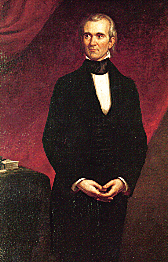
James K. Polk became the first “dark horse,” or little-known candidate, to win the Presidency when he unexpectedly defeated Henry Clay in the election of 1844. At 49 years of age, he was also the youngest president the United States had yet had. During his term of office Polk added to the United States a vast region stretching from the Rocky Mountains to the Pacific Ocean. Antislavery men of his own day condemned him, for they believed that he desired only to extend the area of slavery. But modern scholars deny this and generally rank Polk as one of the 10 greatest American presidents.
Congressman
In 1825 Polk was elected to the United States House of Representatives. There he championed Andrew Jackson, who had just lost the contest for the presidency to John Quincy Adams. Polk proved a courageous and able debater and blunted the effect of the worst attacks against Jackson. When Jackson was elected president in 1828, Polk became one of his most trusted lieutenants, serving without expecting political reward. In 1833 Polk became chairman of the Committee on Ways and Means. Two years later he was elected Speaker of the House of Representatives. He was re-elected Speaker in 1837.
During these years Polk had to preside over some of the stormiest sessions ever known in the House of Representatives. He was heckled unmercifully from the floor of the House and hounded by enemies, some of whom tried to goad him into a duel. Nevertheless, Polk served efficiently if unhappily.
Governor
In 1839 the Tennessee Democrats, hoping to capture control of the state from the Whig Party, nominated Polk for the governorship. Although he would have preferred to remain in Congress, Polk consented to run for the good of the party. He was elected and served a 2-year term, from 1839 to 1841. His success proved more a personal than a party victory, for in the presidential election of 1840 Tennessee cast its vote for the Whig candidate, William Henry Harrison. Polk ran for re-election as governor in 1841 and 1843 but suffered defeat.
The Road to the White House
President Harrison's death in 1841 put Vice-President John Tyler in the White House. Tyler, however, was soon ousted from the Whig Party for vetoing their favorite measures. This immediately raised the question of who would become president in 1844. Senator Henry Clay of Kentucky proposed to take charge of the Whig Party and become its candidate. Former president Martin Van Buren was expected to be the Democratic candidate.
Meanwhile, President Tyler concentrated his efforts upon achieving the annexation of Texas. On April 22, 1844, he submitted a Texas annexation treaty to the Senate. The proposed treaty immediately started a national controversy. The entry of Texas into the Union was popular in the South and Southwest. But many people, in the North and elsewhere, objected because it would add a new slave state to the United States. In addition, they felt that annexation would almost certainly lead to war with Mexico.
On April 27 both Clay and Van Buren published letters opposing statehood for Texas. The Whigs nominated Clay for the presidency shortly thereafter, but all politicians agree that his letter had weakened his hold on the voters of the Southwest. Van Buren's letter, appearing just a month before the Democratic nominating convention, ruined his chances. The aged but still influential Andrew Jackson informed his friends that the Democratic Party and its candidate would have to support annexation. Furthermore, Jackson believed, the Democratic candidate ought to come from the Southwest, to capture Whigs who would refuse to vote for Clay. Jackson suggested James K. Polk—who had been mentioned as a possible vice-presidential candidate—as a man who could lead the Democrats to victory.
“Who Is James K. Polk?”
The Democratic National Convention met in Baltimore, Maryland, in May, 1844. The delegates took Andrew Jackson's advice and nominated Polk on the ninth ballot. George M. Dallas (1792-1864) of Pennsylvania became the Vice-Presidential candidate. Polk's success against men much better known prompted the Whigs to ask mockingly: “Who is James K. Polk?”
The Democrats adopted a platform calling for the annexation of Texas and the “reoccupation” of the whole of Oregon. The vast Oregon Territory included present-day Washington, Oregon, and Idaho; parts of Montana and Wyoming; and a large area of western Canada. Since 1818 it had been occupied by both Great Britain and the United States. The Democratic platform emphasized Polk's own devotion to Manifest Destiny—the concept that the United States must continue to expand across the North American continent.
President Tyler, who had accepted renomination, withdrew from the campaign and threw his support to Polk. In return, Polk promised to support the immediate annexation of Texas. On December 3, 1844, Tyler recommended annexation by a joint resolution of Congress. The next day, December 4, Polk won the presidency over Clay by an Electoral vote of 170 to 105. Polk received 1,337,243 popular votes to Clay's 1,299,062. James G. Birney (1792-1857) of the Liberty Party, an antislavery party, received 62,300 votes. The vote for Birney's party in New York cost Clay the electors of that state and gave the victory to Polk. Tennessee, Polk’s home state, gave its electoral votes to Clay by a margin of only 113 popular votes. The election was one of the closest in American history.
On March 1, 1845, just before Polk’s inauguration, President Tyler signed the joint resolution authorizing the annexation of Texas. Polk had thus redeemed half of his party's platform pledge three days before entering the White House.
President
Polk was keenly aware that many leading Democrats doubted his qualifications for the presidency and expected to control his administration. He therefore felt a special compulsion to act firmly and with independence. His determination to exercise all his powers as president made him excessively suspicious of advice. Although he early decided to serve only one term, Polk asked all his cabinet members to pledge not to seek the presidential nomination in 1848. He hoped by this means to prevent conflicts of private ambition from interfering with public business. But his efforts weakened party leadership.
At the beginning of his administration, Polk told his Secretary of the Navy, George Bancroft (1800-91),
“There are four great measures which are to be the measures of my administration: one, a reduction of the tariff; another, the independent treasury; a third, the settlement of the Oregon boundary question; and lastly, the acquisition of California.”
Polk quickly accomplished the first two measures. In 1846 he signed into law the Walker-McKay Tariff, which greatly reduced import taxes. That same year he signed the act restoring the independent treasury system. Under this system the federal government kept its own funds instead of depositing them in state and private banks. The Independent Treasury Act remained in effect until 1913, when the Federal Reserve System was established.
Oregon
Foreign policy, however, dominated Polk’s administration. A major problem was the Oregon boundary, which had long involved the United States and Great Britain in controversy. During the presidential campaign of 1844 the Democrats had demanded American occupation of all of Oregon up to 54-degrees 40' north latitude. This included a large part of what is now British Columbia. A favorite Democratic slogan was “Fifty-four forty or fight.” Polk offered to compromise by setting the disputed boundary at the 49th parallel (its present boundary). But when the British minister curtly refused, the President withdrew the offer and declared his intention to press American claims to the entire region up to 54 degrees 40'. Influenced by Andrew Jackson's dislike of Great Britain, Polk wrote: “The only way to treat John Bull is to look him straight in the eye.” War over Oregon was avoided, however, and on June 15, 1846, the United States and Great Britain signed a treaty setting the boundary at the 49th parallel.
The Mexican War
Polk had determined to acquire California, which was then a part of Mexico. On March 6, 1845, Mexico broke relations with the United States in protest against the annexation of Texas. At this time two Mexican governments were struggling for control, and the distracted nation had failed to pay an installment on some $3,000,000 in claims owed to American citizens. Polk tried to use these circumstances to persuade the government of President Jose Herrera (1792-1854) to accept the Rio Grande as the southern boundary of Texas and to sell California.
Polk sent Senator John Slidell (1793-1871) to offer Mexico $25,000,000 plus the $3,000,000 in claims for the territory. The effort failed. Polk then decided to recommend war. In May, 1846, he learned that Mexican troops had attacked General Zachary Taylor’s forces along the Rio Grande, in territory claimed by both Mexico and Texas. Polk told Congress that Mexico had shed American blood on American soil, and he called for war. Congress declared war on May 13, 1846. The conflict caused great resentment in the northeastern states. Many Northerners felt that the war was unjustified and motivated by a Southern desire to expand the area of slavery.
The fighting lasted about a year and a half. General Taylor seized northern Mexico, and American forces occupied California. In September, 1847, General Winfield Scott (1786-1866) captured Mexico City. The treaty of Guadalupe Hidalgo, ending the war, was ratified by the Senate on March 10, 1848. By its terms the United States acquired California and New Mexico (including parts of present-day Nevada, Arizona, Utah, and Colorado). The United States paid Mexico $15,000,000 and assumed the $3,000,000 owed to American citizens.
The Polk Doctrine
In his first annual message to Congress in 1845, Polk set forth the Polk Doctrine, an extension of the Monroe Doctrine. Polk declared that the United States opposed “any European interference” in any country in the Americas. In addition, the United States would resist even the voluntary transfer of such a country or territory to a European power. In 1848 Polk applied this doctrine to prevent Yucatan, a rebellious province of Mexico, from uniting itself to Spain or Great Britain. Latin-American nations, now fearful of the United States, challenged the Polk Doctrine as an invasion of their sovereignty. Polk defended it on the ground that only a firm stand by the United States would prevent European control of weak American nations.
Polk's administration represents the point when the United States began to regard itself as the equal of Europe. In his last annual message to Congress, Polk proudly announced that with the addition of the new territories “the United States are now estimated to be nearly as large as the whole of Europe.”
Many other events occurred during Polk's administration. The Department of the Interior was established. Wisconsin and Iowa as well as Texas became states, while Minnesota and Oregon became federal territories. Congressman David Wilmot (1814-68) introduced the Wilmot Proviso to prohibit slavery in any territory acquired from Mexico. Though Wilmot's measure did not pass the Senate, it became the basis of the antislavery Free Soil Party and later of the Republican Party.
Life in the White House
Polk showed little imagination or humor. He organized his life methodically, seeking workable answers to practical problems. He labored harder and longer than perhaps any other president of the United States. During his 4 years as president Polk spent only 37 days away from his desk. He arose at daybreak and applied himself to state business usually until midnight. Before going to bed, he carefully recorded in a diary the details of the day's activities.
Sarah Polk greatly aided her husband. She maintained social life at the White House on a dignified and formal level, permitting no card-playing, liquor, or dancing. She had political intelligence and social grace, and she was able to give her husband some protection from the constant pressure of office-seekers. The Polks had no children.
Polk was succeeded as president by General Zachary Taylor, a hero of the Mexican War. Worn out by his unceasing labor, Polk died on June 15, 1849, scarcely 3 months after leaving office. He was buried at his home, Polk Place, in Nashville, Tennessee. In 1893 his body was moved to the state capitol grounds at Nashville.
Philip S. Klein
The Pennsylvania State University