








WILIAM HENRY HARRISON
Biography
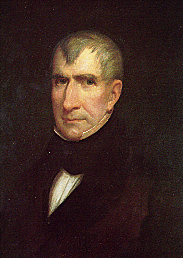
William Henry Harrison had the shortest term in office of any U.S. President. He died one month after his inauguration in 1841 and was the first president to die while in office.
Before becoming president, Harrison had served as a soldier, territorial governor, congressman, senator, and diplomat. But it was his military career that won him the greatest fame and popularity with American voters. During the election campaign of 1840, Harrison's supporters pictured him as the “log cabin” candidate. Actually, he had been born into one of the most distinguished families in Virginia and raised on a large plantation.
Early Years and Career
Harrison was born on February 9, 1773, at his father's plantation, Berkeley, in Charles City County, Virginia. His father, Benjamin Harrison, was one of the signers of the Declaration of Independence, a close friend of George Washington, and governor of Virginia. William Henry was the youngest of the seven Harrison children. He received his early education at home and attended Virginia's Hampden-Sidney College without gaining a degree. His father wanted him to become a doctor, so William was sent to study medicine in Richmond and Philadelphia. When his father died in 1791, Harrison gave up medicine to join the Army.
In 1791 the 18-year-old Harrison, newly commissioned as an ensign in the First Regiment of Infantry, arrived in Fort Washington (now Cincinnati, Ohio) in the Northwest Territory. Indian wars were then raging in this frontier region, and young Harrison learned his trade as a soldier fighting Indians.
In 1792, General Anthony Wayne arrived to take command of the American forces. Wayne, impressed by Harrison's abilities, promoted him to second lieutenant and made him his aide-de-camp, or assistant. In 1794 the Indians were defeated at the Battle of Fallen Timbers, in which Harrison was cited for bravery. The Treaty of Greenville, signed in 1795, divided the territory between the Indians and settlers and ended the Indian wars for a time.
Marriage and Family
Harrison was promoted to captain and placed in command of Fort Washington. There in 1795 he married Anna Symmes, the daughter of Judge John C. Symmes, a wealthy landowner and an important figure in the Northwest Territory. Judge Symmes did not approve of the match, believing that his daughter was throwing herself away on a young man with poor prospects.
The Harrisons had ten children in all, of whom four lived to see Harrison become president. One son, John Scott Harrison, was the father of Benjamin Harrison, who became the 23rd president of the United States.
Dissatisfied with the low pay and lack of advancement, Harrison resigned from the Army in 1798 and was appointed secretary of the Northwest Territory by President John Adams. The following year, Harrison was elected as the territory's first delegate to Congress.
In Congress, Harrison played a leading role in the creation of the territories of Ohio and Indiana from the old Northwest Territory. In 1800 he was appointed governor of the Indiana Territory (which included all or parts of the present-day states of Indiana, Illinois, Wisconsin, Michigan, and Minnesota).
Harrison served as governor of Indiana for twelve years and was responsible for many improvements in the territory. He also tried to be fair in his dealings with the Indian tribes. But he was handicapped by the white settlers and the federal government
.Indian Disputes: Tippecanoe
Over the years the Indians were slowly deprived of their lands in the Northwest by a series of treaties. The Treaty of Fort Wayne in 1809 caused strong opposition among the tribes. Led by the Shawnee chief Tecumseh and his brother Tenskwatawa, known as the Prophet, they formed a confederation to stop the settlers’ advance.
In 1810, Tecumseh met with Harrison and warned him that the Indian tribes would oppose the occupation of their land under the terms of the Treaty of Fort Wayne. Harrison insisted that the treaty would be carried out. In 1811 he led a force of about 800 regular soldiers, militia, and volunteers against the Shawnees near Tippecanoe Creek. The Indians, under Tenskwatawa, were defeated and their settlement was burned. The battle did little to curb the tribes, but it won fame and the nickname “Old Tippecanoe” for Harrison.
War of 1812
Meanwhile, the growing difficulties between the United States and Britain were erupting into the War of 1812. Harrison returned to military service as brigadier general and was given command of the Army of the Northwest. Promoted to major general, he was ordered to retake Detroit, which had been captured by the British, and to invade Canada. Detroit was recaptured on September 29, 1813. On October 5, 1813, Harrison defeated the British at the Battle of the Thames in southern Ontario. In the battle Tecumseh was killed while fighting on the side of the British.
Harrison's victory made him famous. But he took part in little military activity during the rest of the war. In 1814 he again resigned from the Army.
Return to Politics
Harrison returned to his home and family at North Bend, Ohio, where he sought to improve his finances. In 1816 he was elected to the U.S. House of Representatives, serving until 1819. After failing to gain appointment as minister to Russia in 1819, he won election to the Ohio State Senate. In 1825 he was elected to the U.S. Senate, where he served as chairman of the committee on military affairs.
Minister to Colombia
Harrison resigned from the Senate in 1828, when President John Quincy Adams appointed him minister to Colombia. Harrison's venture into diplomacy was not a success. He took the attitude that the United States should act as a big brother to the newly independent republics of South America. He offended Colombian President Simon Bolivar when he bluntly suggested that Bolivar take care not to become a dictator. Harrison was recalled as minister in 1829 by the new president, Andrew Jackson.
Road to the Presidency
Harrison was nominated for the presidency in 1836 by the Whig Party, which had been formed in opposition to the policies of President Andrew Jackson and the Democrats. Although Harrison was defeated in the election by Martin Van Buren, Jackson's Vice President, he made such a good showing that the Whigs again nominated him to oppose Van Buren in the 1840 election.
During the 1840 campaign, the Whigs made the most of Harrison as a military hero and a man of the people, as opposed to the aristocratic Van Buren. The Democrats responded with ridicule, saying that all Harrison wanted was a barrel of hard cider, a pension, and a log cabin.
The Whigs turned this to their advantage, referring to Harrison as the “log cabin and hard cider” candidate and using a log cabin and a barrel of cider as their campaign symbols. John Tyler of Virginia was Harrison's vice presidential running mate and the Whig slogan was “Tippecanoe and Tyler, too!” Harrison's popularity as well as an economic depression, which had begun in 1837, contributed to Van Buren's defeat. Harrison won an overwhelming victory, receiving 234 electoral votes to Van Buren's 60.
A Short Tenure
But the excitement of the inauguration and the demands of political job seekers proved too much for the 68-year-old Harrison's failing strength. Soon after taking office on March 4, 1841, he caught a cold that developed into pneumonia. He died on April 4, 1841. His last words were, “I wish you to understand the true principles of government. I wish them carried out. I ask nothing more.” On April 6, 1841, Vice President John Tyler was sworn in as 10th president.
Reviewed by Richard B. Morris
Editor, Encyclopedia of American History