








MARTIN VAN BUREN
Biography
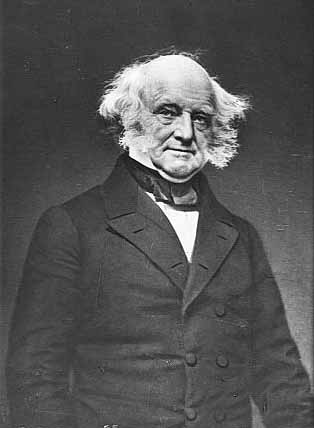
On March 4, 1837, Martin Van Buren succeeded his close friend Andrew Jackson as President Of The United States. At the time, the country was prosperous, the Democratic Party was supreme, and the incoming President seemed superbly trained for his office. Van Buren had been Vice President and secretary of state under Jackson, minister to Great Britain, United States senator, and governor and attorney general of New York. He had been nominated unanimously by his party's convention. In the election of 1836 he had been swept into power, defeating William Henry Harrison by 170 to 73 Electoral votes.
But within a matter of weeks President Van Buren had a major depression on his hands. The Panic of 1837 began with the collapse of business and the wholesale failure of banks. Thousands of city people were out of work in a country that had never been through such an experience. The United States had no government machinery to underwrite loans, create jobs, feed the hungry, or bolster the farm market. In the rural sections people continued to lead normal lives. But in the cities mobs stormed the warehouses for food, flocked to the poorhouses, and committed crimes so they could go to jail, where they could at least survive. “Where will it all end?” wrote Philip Hone, a former mayor of New York, in his diary. “In ruin, revolution, perhaps civil war!”
Fortunately the United States had a beckoning frontier, which absorbed some of the unrest, and Van Buren behaved with courage and dignity to restore confidence. He believed that the panic had been caused by too much land speculation (buying and selling land for a quick profit) and that it would run its course. He was right. Within 2 years prosperity was returning, but too late to save him politically. Van Buren was badly defeated by Harrison in the election of 1840. He suffered what to him was the disgrace of being a one-term president.
Van Buren was the first president to be born under the American flag; the first New Yorker to hold the office of president; and the first man to be nominated for the presidency by the Democratic Party under that name. He was a short, plump, jolly man with side-whiskers. His personal charm earned him many friends, even among his political opponents. He probably had more comic nicknames than any other occupant of the White House—the Red Fox, the Little Magician, the Careful Dutchman, and variations on these themes. He was not a statesman, but he was a thoroughly honest, generous, and incredibly clever politician.
His Ambition
In his autobiography, published after his death, Van Buren good-humoredly recounts his youthful adventures and climb to power. He makes no secret of his life's ambition. He wanted to become president. He called that office “the glittering prize“ and “my most earnest desire.”
Van Buren's career can be understood only by taking him at his word. Every office he held was a stepping-stone to the White House. In 1821 he went to Washington as a United States senator. He left his unfinished second Senate term to run for governor of New York in 1828. He remained governor only 10 weeks, returning to Washington to be near President Jackson as his secretary of state and political manager.
Van Buren resigned as head of the State Department in 1831 to allow Jackson to get rid of his Cabinet members who were followers of Vice President John C. Calhoun, Jackson's political enemy. Jackson then appointed Van Buren minister to Great Britain, but he served less than 5 months. The Senate rejected his confirmation by the deciding vote of John C. Calhoun. When Jackson won re-election in 1832, however, Van Buren became the new Vice President. He was then, as Jackson's favorite, almost certain to win the presidency in 1836.
President
Once Van Buren reached the White House, he did leave “politics” alone. The Panic of 1837 was no fault of his, coming when he had barely reached office. President Jackson's financial policies had sowed the whirlwind that his successor had to reap. As the first president from the West, Jackson had reason to feel that the Eastern money interests held the frontier areas in a financial vise. Old Hickory withdrew federal deposits from the Bank of America in Philadelphia and distributed them in banks around the country. The result was a splurge of investment, followed by a sudden loss of confidence in the banks.
Van Buren's handling of the crisis was superb. It was altogether devoid of crafty politics or retreat from principle. He calmly allowed the excitement of the spring and summer to subside, and he set a special session of Congress for September. He then delivered a message in the spirit of Thomas Jefferson. Van Buren said in part: “All communities are apt to look to Government for too much…especially at periods of sudden embarrassment or distress. But this ought not to be. The framers of our excellent Constitution…wisely judged that the less Government interferes with private pursuits the better for general prosperity. ... Its real duty…is…to leave every citizen and every interest to reap, under its benign protection, the reward of virtue, industry and prudence.”
Van Buren was not heartless, although his enemies painted him as such. His administration enacted legislation that established the independent treasury system and made sound-money loans available through local banks. Foreign relations were troubled during his term by a boundary dispute with Canada and by difficulty with Mexico over the secession of Texas. Van Buren skillfully negotiated the dispute with Canada. He refused to accept Texas into the Union because that would mean an additional slave state as well as war with Mexico. He was a good president who dared to be unpopular.
Van Buren's defeat in 1840 can be seen as delayed punishment for his 25 years of playing politics. The Whig Party was organized and led much as the Albany Regency had been. The Whig candidate, General William Henry Harrison, was presented to the country as an “old hero.” He avoided every serious issue. Along with his running mate, John Tyler, Harrison won by an electoral vote of 234 to 60 with the campaign slogan “Tippecanoe and Tyler too.” Van Buren took his defeat with unruffled good humor.
Free-Soil Candidate
Still, Van Buren remained a powerful figure in New York State politics. In 1848 he was nominated as the presidential candidate of the Free-Soil Party, composed mainly of Northerners—both Whigs and Democrats—opposed to the expansion of slavery into the western territories. Van Buren's candidacy, however, split the Democrats and helped General Zachary Taylor, the Whig candidate, defeat Lewis Cass (1782-1866).
Later Years
Van Buren's last years were his happiest. His marriage had ended tragically with Hannah's death in 1819. But she left him four fine sons, who brought him pride and pleasure. John Van Buren became attorney general of New York. Abraham Van Buren married a niece of Dolley Madison, and Smith Thompson Van Buren married a niece of Washington Irving. Martin, Jr., accompanied his father on a 2-year trip through Europe. There the former president, the first to take such a journey, was admired by the crowned heads and the society figures of many countries. These family successes and personal honors helped him to bear the disappointment of being turned out of the White House.
Van Buren had purchased the old Van Ness mansion on the Hudson near Kinderhook and renamed it Lindenwald (Linden Woods) after the trees. There he spent his declining years, pampered by his daughters-in-law, honored by his neighbors and by famous visitors. He died on July 24, 1862, at the age of 79. He would have been pleased to know that 81 carriages, including that of the governor of New York, followed his hearse to the nearby cemetery of the Dutch Reformed Church. His last will and testament beautifully sums up his life: “I, Martin Van Buren ... heretofore Governor of the State and more recently President of the United States, but for the last and happiest years of my life, a Farmer in my native town…”
Holmes Alexander
Author, American Talleyrand: The Career and Contemporaries of Martin Van Buren