








CHESTER ARTHUR
Biography
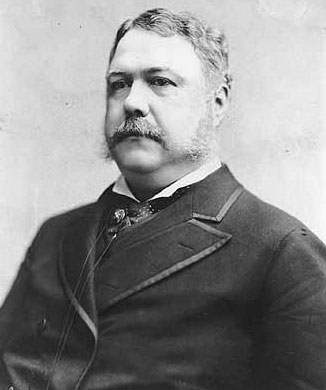
On July 2, 1881, President James A. Garfield was shot in the back by an insane man. For two months the President lay between life and death. On September 19, Garfield died, and early the next morning Vice-President Chester Alan Arthur became the new President of the United States.
Arthur was a handsome man. Tall and broad-shouldered, he impressed people with his dignified bearing and elegant manners. He was courteous and friendly.
But many people considered the handsome Vice President unfit to be president. Arthur had long been associated with the spoils system. Under this system government jobs were awarded for service to a political party, whether the candidates were honest and able or not. In fact, the man who killed President Garfield explained that he did so because he had been refused a government job. People were alarmed that Arthur, a product of the spoils system, had become president.
Arthur’s administration, however, proved to be quite different than his country expected. It was marked by honesty and by the replacement of the spoils system with the present Civil Service system based on merit.
Arthur Enters Politics
Like most lawyers of the time, Arthur also took part in politics. In 1860 he helped organize the New York State Republican Party, and he supported its candidate for governor. As a reward the governor made Arthur engineer in chief and then quartermaster general of New York State. During the Civil War Arthur's position was very important, for all Union Army volunteers were equipped by the state before they were sent on to the Army. Arthur proved skillful and honest in providing thousands of New York soldiers with food, shelter, guns, tents, and other equipment.
Collector of New York
Arthur's work for the Republican Party brought him to the attention of Senator Roscoe Conkling, the political boss of New York State. Arthur became Conkling’s lieutenant and worked with him to win the election of Ulysses S. Grant in 1868. For his help President Grant in 1871 appointed Arthur collector of customs for the port of New York.
The collector was in charge of the New York Custom House, which received most of the customs duties of the United States. He also had the power to distribute more than 1,000 jobs. Under the spoils system these jobs went to faithful Republicans. They were expected to work for the party as well as for the Custom House. In the years that Arthur held the position he simply followed the old system, although he himself remained an honest and able administrator.
But many people were becoming angry about the inefficiency of the spoils system. They wanted a merit system, under which officeholders would be chosen on the basis of ability. In 1877 Rutherford B. Hayes, a believer in the merit system, became president. Hayes ordered an investigation of the New York Custom House, and in 1878 Arthur was dismissed from his post. The conflict caused a deep split in the Republican Party. The supporters of the old system became known as Stalwarts. The reformers were called Half-Breeds.
Vice-President
In 1880 the Republicans who met to pick a new candidate for president were still bitterly divided. The delegates voted 36 times before they agreed on a candidate whom no one had expected—James A. Garfield, a Half-Breed. However, Senator Conkling was Garfield's political enemy. And to gain the support of the Stalwarts, the Garfield men nominated Arthur for the vice-presidency. The Republicans won in a close election. Ten months later Garfield was dead, and Arthur became the 21st president of the United States.
President Arthur Surprises Many People
As president, Arthur surprised both his friends and enemies. Arthur wished to make a good record for himself and was eager to be renominated and re-elected. He knew that he would never gain the support of reform and independent voters if he acted simply as a tool of Boss Conkling.
Arthur therefore determined not to let his administration be disgraced by the spoils system. He also tried earnestly to deal with some of the serious political problems the nation faced. But he was not so successful as he wished because he never had the full support of Congress.
For many years the Senate and the House of Representatives had gained power at the expense of weak presidents. Even such a strong personality as Abraham Lincoln had trouble with Congress. And his successors—Johnson, Grant, and Hayes—had let themselves be dominated by powerful Congressional leaders. Arthur was especially defenseless. He had become president by accident, and he did not command the support of any strong group in Congress.
Furthermore, Congress was itself divided. Both the Democratic and Republican parties were split into warring groups like the Stalwarts and the Half-Breeds. Some questions, such as the tariff (the tax on goods imported into the country), also divided the legislators. Other issues, such as the currency, set farmers, laborers, and manufacturers fighting one another.
Most important of all, the country was expanding and growing rich. Many people thought only of what they could get for themselves. Their representatives did not vote according to what was best for the nation as a whole. Instead they voted for laws that would gain the most for their supporters. Under such conditions it was difficult even for an able president to work out a good national policy. Arthur tried his best. But his achievements were limited.
The Pendleton Act and the Merit System
Before Arthur took office, it became known that some postal officials had collected money illegally in arranging mail routes. They were brought to trial in the famous Star Route cases. They were never convicted, but the trial made many more Americans aware of the evils of the spoils system.
With President Arthur's support, Congress now tried to introduce the merit system. In 1883, Arthur signed a law that helped take thousands of government jobs out of politics. This was the Pendleton Civil Service Act. It required candidates for many government jobs to pass tests before they could be accepted. Men who qualified were protected against being dismissed for political reasons. The Pendleton Act was the beginning of the present United States Civil Service.
Too Much Money and Chinese Exclusion
During the 1880's the United States had an unusual problem: there was too much money in the treasury. In one year the government collected $80,000,000 more than it spent. This kept money out of circulation, hurt business, and caused prices to fall. Arthur wanted to solve the problem by lowering the tariff. Congress, however, refused to do so. It preferred to spend the money on a “pork-barrel” bill. This was a law that authorized federal funds to be spent on river and harbor improvements. Such a law won votes for the congressmen and senators of the favored states. Arthur rejected the bill even though he knew that this would make him unpopular. But Congress passed it over his veto, and the tariff problem was not solved during Arthur's term in office.
Congress also passed the Chinese Exclusion Act of 1882 against the president's wishes. Its aim was to prevent Chinese from immigrating to the United States. Arthur opposed the bill because it violated a treaty between China and the United States. His opposition forced Congress to rewrite the law so that it had fewer harsh restrictions against the Chinese.
Not All Was Politics
In 1859 Arthur had married Ellen Lewis Herndon, the daughter of a Virginia naval officer. Mrs. Arthur died in 1880, before her husband became president. Each day President Arthur honored her by placing fresh flowers in front of her picture.
The President's favorite sport was fishing. He was considered one of the best salmon fishermen in the country. Arthur was also fond of good food and companionship. He enjoyed the dinners to which he was invited and hated to leave. Since none of the guests could politely leave before the President, the dinners sometimes lasted until midnight.
Arthur liked elegant surroundings, and he had the White House completely redecorated. He installed new plumbing, a new bathroom, and the first elevator in the White House. His sister, who acted as hostess, helped him make it Washington's social center.
Arthur is Rejected by the Republicans
In 1884 the Republicans did not renominate Arthur for president. The Half-Breed reformers were still not satisfied with him, and his old Stalwart friends, of course, were now against him. James G. Blaine was nominated and later lost the election to Democrat Grover Cleveland.
Arthur returned to his old law practice. But his health was failing. On November 18, 1886, at the age of 56, he died at his home in New York.
Chester Arthur was an honest and courageous president. But the political situation of his times did not permit him to deal successfully with the country's great problems. The greatest achievement of his administration was the Pendleton Civil Service Act. However, he will be best remembered as the spoils system politician who became president by accident, and who proved himself a better man than anyone expected.
Oscar Handlin
Harvard University