









ULYSSES S. GRANT
Biography
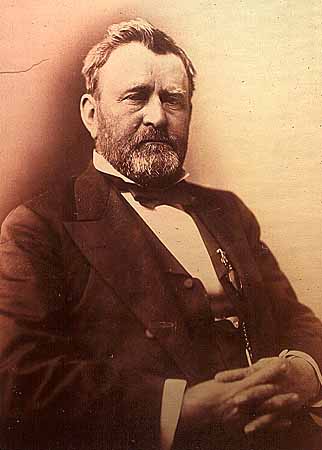
On February 16, 1862, during the Civil War, a Union soldier carried a message from his general to the battle-weary Confederate forces defending Fort Donelson in Tennessee. The Confederate commander had asked for terms upon which he could surrender the fort. The 39-year-old Union general, Ulysses S. Grant, replied that only “an unconditional and immediate surrender” would be accepted. This phrase, and the man who said it, at once captured the attention of the country. U. S. Grant became Unconditional Surrender Grant.
The surrender of Fort Donelson was an important victory for the North. For Grant it was also a great personal victory after years of failure. Within two years he would become commander of all the Union armies, and a few years later President of the United States.
Grant also shares something in common with anohter U.S. President, Harry S Truman, in there is some confusion and little-know facts about their middle names. Grant was born on April 27, 1822, at Point Pleasant, Ohio, the eldest son of Jesse Root Grant and Hannah Simpson Grant. He was named Hiram Ulysses, but he was always called Ulysses. In 1839 Grant's father obtained an appointment for him to the U.S. Military Academy at West Point. The congressman who made the arrangements mistakenly referred to him as Ulysses Simpson Grant, and the name remained with him ever afterward.
Early Military Career
Grant requested duty in the cavalry, but there were no openings. Instead, he was assigned to the 4th Infantry Regiment. He was in Texas when war with Mexico broke out in 1846.
Grant was not in sympathy with the aims of the Mexican War. He felt that the United States was not completely right in its actions and was bullying a smaller nation. However, as a soldier, he fought bravely in nearly all the major battles of the war and was promoted to first lieutenant.
As soon as the war ended in 1848, Grant asked for leave. In August 1848, he married Julia Dent (1826–1902), the sister of one of his classmates at West Point. Julia was to be a source of strength to Grant for the rest of his life. Grant had since given up the idea of teaching and had decided to stay in the Army for a time.
In 1852, Grant was ordered to the Pacific Coast. Because his pay as a lieutenant was so low, he could not afford to take his wife and young son with him. In 1853 he was promoted to captain. But even a captain's pay was too low to support his family in the West. Grant was lonely and homesick. According to army gossip, he began to drink, although there is no official record to support this. After quarreling with his commanding officer, Grant resigned from the Army in 1854.
Years of Failure
Grant settled with his family in Missouri, intending to become a farmer. He started a farm on land owned by his wife and labored for three years, but bad economic conditions and illness made him quit. He then became a partner in a real estate agency. However, his lack of business experience forced him to give it up. He ran for the office of county engineer but was defeated.
In desperation, Grant took a job as a partner and clerk in a leather goods store operated by his two brothers in Galena, Illinois. But his civilian life soon was to be interrupted by war.
Civil War General
The growing troubles between the North and the South came to a head with the election of Abraham Lincoln to the presidency in 1860. In December 1860, South Carolina seceded from the Union and was soon followed by other Southern states who formed the Confederate States of America. On April 13, 1861, Fort Sumter fell. Two days later President Lincoln called for 75,000 volunteers for the Army. The Civil War had begun.
Grant offered his services to the Union and was commissioned colonel of the 21st Illinois Volunteer Regiment. In August 1861, Grant read in a newspaper that President Lincoln had made him a brigadier general. Communications were so slow that he had received no notice of the promotion before.
Trial and Acclaim
Grant's first real battle in the Civil War took place at Belmont, Missouri. His troops drove the Confederate forces from their camp and destroyed it. But the Southerners counterattacked with additional forces, and Grant had to retreat. It was a bitter lesson, but he learned from it. His next campaign led to the capture of Fort Donelson. The surrender of this important fort made Grant a hero in the North, and President Lincoln promoted him to major general of volunteers.
Union Army Commander
Grant repaid Lincoln's confidence by capturing the Confederate stronghold of Vicksburg, Mississippi, in 1863, giving the Union forces control of the Mississippi River. In 1864, Grant was promoted to the rank of lieutenant general and was given command of all the Union armies. He proceeded to hammer the Confederate forces in Virginia under General Robert E. Lee. It was a long, bloody campaign, for Lee was a great general. But the Southerners were greatly outnumbered, and on April 9, 1865, Lee surrendered to Grant at Appomattox Court House, Virginia.
A grateful U.S. Congress appointed Grant a full general. He was the first man to hold this rank since George Washington.
President
Because of Grant's great popularity, the Republicans nominated him for the presidency in 1868. Grant disliked politics and did not actively campaign, but he easily defeated the Democratic candidate, former New York governor Horatio Seymour. Grant won re-election in 1872, defeating Horace Greeley, a New York newspaper editor and publisher.
Modest and unassuming, Grant tried to run the government the only way he knew--as a military operation. But his presidency was marked by scandal and corruption because he did not always choose the best men for political jobs. He was so honest himself that he found it hard to believe that anyone he trusted could betray him. Yet in one case Grant's own brother-in-law involved him in a financial scandal. His personal secretary also was implicated in one of the most notorious scandals, that of the Whiskey Ring, which sought to evade U.S. taxes in the manufacture of whiskey.
Achievements
At home, Grant supported the rights of the freed blacks in the South. He opposed the recently-organized Ku Klux Klan (KKK), which sought through acts of terrorism to prevent blacks from voting. The most notable achievement of his administration, however, was the settlement of the Alabama claims dispute with Britain in 1872. The Alabama had been one of several Confederate warships built by Britain during the Civil War. The United States demanded compensation for damages done to the Union merchant marine by these ships and was awarded $15.5 million.
Later Years
Upon leaving the White House in 1877, Grant and his family went on a two-year tour around the world. After returning to the United States, Grant was supported by some Republicans to run for the presidency again, in 1880, but he lost the nomination to James A. Garfield.
Grant's last years were difficult ones. He lost the little money he had through bad investments. Penniless, he began to write his memoirs to provide for his family. Congress restored him to the retired list, with his old rank of general, to help relieve his financial burdens. But by this time Grant had little time left, for he was dying of cancer. Although in great pain, he continued to work on his memoirs. He finished them about one week before he died on July 23, 1885, at Mount McGregor, New York. His body and that of his wife, Julia, lie in a magnificent tomb, built especially for him, in New York City.
Grant's presidency in the years following the Civil War came at a time of political turmoil for the United States. Although he was not successful as president, he remains one of the great American military leaders. His personal qualities were more than admirable, and it is for these he should be remembered.
Reviewed by Ulysses S. Grant 3rd
Maj. General, U.S. Army (ret.)