








JAMES BUCHANAN
Biography
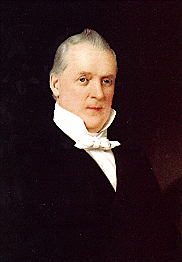
James Buchanan, the 15th President of the United States, also served his country as a congressman, senator, ambassador, and secretary of state. But many people remember mainly two things about him: that he was the only president who never married; and that the Civil War followed his administration.
When James was 16, his father sent him to Dickinson College in Carlisle, Pennsylvania. Young Buchanan was a serious student, but he also wanted to have a good time. He began to drink and smoke with some of the other students. Even though his marks were excellent, he was expelled for bad conduct at the end of his first term. James pleaded to be taken back and promised to turn over a new leaf. He was allowed to return and went on to graduate with honors.
Buchanan then went to Lancaster, Pennsylvania, to study law. Hard work and intelligence made him a very good lawyer. Before long he was earning more than $11,000 a year, a huge sum in those days.
In 1814, Buchanan became a candidate for the Pennsylvania legislature. But the War of 1812 was raging, and the British had just burned Washington. Buchanan felt that the United States should not have gone to war against Great Britain. However, he knew it was his duty to serve his country, and he joined a volunteer cavalry company.
Buchanan returned in time for the election and won his seat in the legislature. He served a second term and then returned to Lancaster to continue his law practice.
A Tragic Love Story
As his practice grew, Buchanan became an important figure in town. He was invited to parties at some of the best homes in Lancaster. At one party he met and fell in love with beautiful Ann Coleman. In 1819 Ann and James were engaged to be married, but their happiness was destined to end quickly.
During the fall of 1819 Buchanan often had to be out of town on business. While he was away rumors spread that he wanted to marry Ann only for her money. There was gossip about another woman. All of this was untrue, but Ann was heartbroken. Because of a misunderstanding, she broke her engagement to James.
A short time later Ann died. Buchanan was so grief-stricken that he vowed he would never marry. Years later, after his death, a package of Ann's letters, yellow with age, was found among his papers. They were burned, according to his last wishes, without being opened.
He Returns to Politics
Buchanan turned to politics to forget his sorrow. The Federalist Party was looking for a candidate for Congress. Buchanan agreed to run, and in 1820 he was elected to the House of Representatives, where he served for 10 years. During his years in Congress, Buchanan changed his political party. He joined the Jacksonian Democrats (named for Andrew Jackson), and became a leader of the Jacksonians in Pennsylvania.
In 1831 President Jackson asked Buchanan to become minister to Russia. Buchanan went to Russia the following year. While there he negotiated the first trade agreement between Russia and the United States.
On his return to the United States, Buchanan was elected to the Senate. He served until 1845, and became chairman of the important committee on foreign affairs.
Buchanan applied all his training as a lawyer to his work in the Senate. The Constitution, he said, was the basis of all political power. But the Constitution also strictly limited the powers of the federal government. Buchanan believed that a constitutional republic could adjust serious differences between its people only by compromise and legal procedure.
Secretary of State
By 1844 Buchanan had become an important political figure. Though he hoped for the presidential nomination, he gave his support to James K. Polk, who won the nomination and the Election. President Polk appointed Buchanan secretary of state.
During Polk's term as president, war broke out between the United States and Mexico. Buchanan, as secretary of state, helped to arrange the treaty of peace in 1848. By this Treaty of Guadalupe Hidalgo the United States purchased from Mexico the region extending west from Texas to the Pacific Ocean.
Another problem concerned the vast Oregon territory, which both Great Britain and the United States claimed. The dispute became so bad that war threatened. But Buchanan arranged a compromise, and the Oregon Treaty of 1846 settled the Northwestern boundary between Canada and the United States.
When Polk left office, Buchanan also retired. For 4 years he lived the life of a country gentleman. He bought the famous mansion, Wheatland, near Lancaster, Pennsylvania, partly to have a suitable place to entertain political guests, but mainly to care for a growing family. Although Buchanan remained a bachelor, he had over the years become a kind of foster father to a score of nephews and nieces, seven of them orphans. They often visited him at Wheatland, and two made their home with him there, cared for in his absence by his faithful housekeeper, Miss Hetty Parker.
But Buchanan could not stay out of politics for long. In 1852 he was again a candidate for the presidential nomination. He was beaten by a little-known candidate, Franklin Pierce.
Minister to Great Britain
President Pierce made Buchanan minister to Great Britain in 1853. Shortly thereafter Pierce instructed the American ministers in Europe to draw up proposals to "detach" Cuba from Spain. This led to the Ostend Manifesto, named after the Belgian city where the ministers met. The Manifesto defined a plan to purchase Cuba. But it also included a proposal many people condemned: that the United States would be justified in seizing Cuba if Spain refused to sell the island. Buchanan's political opponents severely denounced the Ostend Manifesto, and nothing ever came of the plan. Buchanan wrote of it: “Never did I obey any instructions so reluctantly.”
While Buchanan was in England, Congress passed the Kansas-Nebraska Act, permitting slavery in regions of the Northwest from which the Missouri Compromise of 1820 had formerly excluded it. This new law marked the beginning of the Republican Party, which vowed to prevent any further expansion of slavery, and it split the Democratic Party into northern and southern groups. As Buchanan had been in England during the Congressional fight over the Kansas-Nebraska bill, he remained friendly with both sections of his party. When the Democrats met in 1856 to pick a new candidate for president, they needed someone who would be accepted by both the North and the South. Buchanan proved to be the man. This time he won the nomination and the election.
President Buchanan
On March 4, 1857, Buchanan was inaugurated as president. Since Buchanan had no wife, his 27-year-old orphan niece, Harriet Lane, acted as his hostess. She was very popular, and Buchanan's administration was a great social success. White House guests included the first Japanese representatives to the United States and the Prince of Wales (who later became King Edward VII of England). The prince arrived with such a large party that the President had to give up his own bed and sleep on a couch.
The Dred Scott Decision
But the political situation was getting worse. Two days after Buchanan's inauguration, the Supreme Court gave its historic decision in the case of the slave Dred Scott, who sued for his freedom because he had been taken to a nonslave territory. However, the court decided that Congress could not outlaw slavery in United States territories. Buchanan thought slavery was wrong, but unfortunately the Constitution then recognized it. He hoped the Dred Scott decision would calm the country. Instead, people in the North refused to accept the court's decision. Thus the North and South became more divided than ever.
South Carolina Secedes from the Union
The crisis came in December, 1860. Abraham Lincoln had just been elected president, but he did not take office until March, 1861. Until that time Buchanan was still president.
When the news of Lincoln’s victory reached the South, the state of South Carolina seceded from the Union, declaring that it was no longer a part of the United States. By February, 1861, six more southern states had broken away from the Union. The split in the nation that Buchanan feared had taken place.
In this crisis Buchanan wanted to keep the remaining slave states loyal to the Union. He said he would do nothing to provoke a war but he would try to protect federal property and enforce the laws in the South. He asked Congress to call a Constitutional Convention and to vote him the men and money needed to enforce the laws. But Congress refused.
The Coming of War
On March 5, 1861, Buchanan left Washington and returned to Wheatland. He was happy to leave the presidency and hopeful that the president who followed him could maintain peace and restore the Union. But fiveweeks after Lincoln's inauguration, the South fired on Fort Sumter and the Civil War began.
Buchanan spent his last years writing a book about his term as president. He died at Wheatland on June 1, 1868.
Could Buchanan have prevented the Civil War? Historians do not agree. Some say that a stronger president, one with more imagination, could have prevented the war. Others argue that the Civil War was inevitable: it would have happened no matter who was president, and if Buchanan had used force against the southern states, the war would only have started earlier.
Buchanan tried to solve the problems of the United States by acting within its laws. He failed. Whether any man could have succeeded will never be known.
Reviewed by Philip S. Klein
Author, President James Buchanan