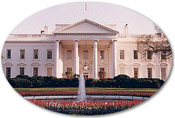









GERALD R. FORD
Biography
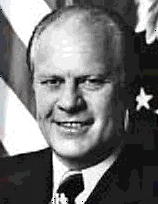
Gerald R. Ford became president of the United States under unique circumstances. As vice president, he succeeded to the presidency on the resignation of Richard M. Nixon in 1974, during the Watergate scandal. It was the first time in U.S. history that a Vice President had assumed the presidency because of the resignation of the chief executive.
Ford was also the first person to become president without having been elected president or vice president. He had been appointed vice president by President Nixon in 1973 to replace Vice President Spiro T. Agnew, who had been forced to resign his office.
Ford was born on July 14, 1913, in Omaha, Nebraska, the only child of Leslie Lynch King and Dorothy Gardner King. He was originally named Leslie Lynch King, Jr., after his father. His parents were divorced when he was 2 years old, and his mother moved with him to Grand Rapids, Michigan. There she married Gerald Rudolph Ford, who adopted the boy and gave him his own name.
Politics and Marriage
Ford set up a law practice in Grand Rapids and became active in local Republican politics. Michigan Senator Arthur Vandenberg, who also came from Grand Rapids, encouraged him to run for Congress. Ford won election to the House of Representatives from Michigan's Fifth Congressional District in 1948. He was re-elected twelve times, until he resigned from the House in 1973 to become vice president.
On October 15,1948, during the election campaign, Ford had secretly married Elizabeth (Betty) Bloomer Warren. Her previous marriage, to William C. Warren, had ended in divorce in 1947. Born in Chicago, Betty Ford had studied dance with Martha Graham, had been a model in New York, and had worked as a fashion co-ordinator for a Grand Rapids department store.
After their marriage the couple moved to Washington, D.C. They eventually moved into a house in nearby Alexandria, Virginia, where they lived until Ford entered the White House. The couple had four children—Michael, John, Steven, and Susan.
Congressional Career
In Congress, Ford was a conservative in money matters and a vigorous supporter of a strong national defense policy. He was highly respected for his political skill. Assigned in 1949 to the House Committee on Public Works, he declared that he intended to guarantee taxpayers “100 cents of value out of every dollar their government spends.”
In 1951 he was appointed to the House Committee on Appropriations, often called the watchdog of government spending, and from 1953 he also served on that committee's subcommittee on defense. He was increasingly regarded as a hardworking legislator. In his 25 years in the House, in fact, Ford had an attendance record of more than 90 percent. He was not, however, the author of any major legislation during that period, preferring instead to round up support for proposals he favored.
In 1959, Ford's colleagues already were considering him as a possible leader of the House Republicans. In 1960, Michigan Republicans endorsed him as their favorite son candidate for the Republican vice presidential nomination. However, the eventual presidential nominee, Richard M. Nixon, chose Henry Cabot Lodge, Jr., as his running mate instead.
In 1963, Ford was elected by his fellow Republicans to the chairmanship of the Republican House caucus. As the third-ranking member of his party's congressional leadership, Ford fought hard for his positions. But he tried to avoid making enemies of his opponents. He was well liked by both moderate and conservative Republicans and by the Democratic opposition as well.
In 1964, Ford decided to seek the post of Republican minority leader. At the time, Republicans were becoming increasingly concerned over what they felt was weak leadership in Congress. Ford became the champion of those anxious for fresh leadership, and when the issue came to a vote, he was swept into the leadership post.
As House minority leader, Ford became a national Republican leader and a spokesman for the party's conservative wing. Following the election of Richard Nixon to the presidency in 1968, Ford supported the administration's policies in Congress. In 1970 he sponsored a move to investigate liberal Supreme Court justice William O. Douglas.
Vice President
In 1973 it became known that Vice President Spiro Agnew was under investigation for possible violations of the criminal law. Agnew resigned on October 10, 1973. Two days later President Nixon nominated Ford to succeed Agnew under a provision of the Twenty-fifth Amendment to the Constitution. The amendment, ratified in 1967, states that when there is a vacancy in the vice presidency, the president is to nominate a vice president, who takes office on confirmation by a majority vote of Congress. Ford thus became the first appointed vice president.
As vice president, he traveled throughout the country addressing Republican gatherings, seeking support for the President, who was under the cloud of the Watergate scandal. Ford was at home with his family when, on August 8, 1974, Nixon, faced with almost certain impeachment, announced his resignation.
President
On August 9, 1974, the day Nixon’s resignation went into effect, Ford was sworn in as president. In his address on the occasion he declared, “…our long national nightmare is over. Our Constitution works. Our great republic is a government of laws and not of men. Here, the people rule.”
Ford’s succession to the presidency was received with general approval. His reputation for integrity and his openness appealed to most Americans.
Ford chose Nelson A. Rockefeller, a liberal Republican and four-term governor of New York, as his vice president. Then, in his second major act as president, Ford announced that he was pardoning former president Nixon. Ford cited “compassion” and a desire to end controversy as his reasons. The pardon was applauded by some people but criticized by others.
Ford then proclaimed a conditional amnesty for Vietnam War resisters. Under its terms those who had resisted service in the war were to be pardoned in return for civilian service not to exceed two years. The program had limited success, since many war resisters chose not to take part in it. Critics of the program insisted that Ford should have offered unconditional amnesty.
Ford inherited a troubled economy. Inflation, recession, and unemployment had all become worse in the final months of the Nixon administration. Ford attacked the problem with a tax cut and a reduction in federal spending. But although the inflation rate dropped considerably, unemployment remained high. Critics of the President said that he was not doing enough to reduce unemployment, and they called for legislation to create jobs. Such a measure, a public-works bill, was passed by Congress in 1976. Ford vetoed it on the grounds that it would be inflationary, but his veto was overridden. Ford vetoed many bills passed by Congress. This was partly for reasons of economy and partly because of his own ideas of government. Ford believed that the federal government and its bureaucracy had become too big and too complex. Many federal programs, he felt, should be cut back or abandoned entirely.
Foreign Affairs
The fall of the governments of South Vietnam and Cambodia to Communist forces in 1975 was a blow to the administration. Cambodian Communists seized an American merchant ship, Mayagüez, in 1975. This incident attracted worldwide attention. The President ordered U.S. Marines to recover the ship and its remaining crew, which they did successfully. Later the same year, Ford attended a summit conference of world leaders held in Helsinki, Finland.
The Election of 1976
Ford edged out former California governor Ronald Reagan for the Republican presidential nomination in 1976. He was defeated in the election, however, by the Democratic candidate, James Earl (Jimmy) Carter of Georgia.
Although disappointed at not having won a full term as president in his own right, Ford was gracious in defeat. After retiring from the presidency, he served on the board of directors of several corporations. His autobiography, A Time to Heal, was published in 1979. Ford was called on, in the status of an elder statesman, for advice several times in the 1980’s, during Ronald Reagan’s presidency.
Stephen C. Flanders
Political Correspondent, The Columbia Broadcasting System