








DWIGHT D. EISENHOWER
Biography
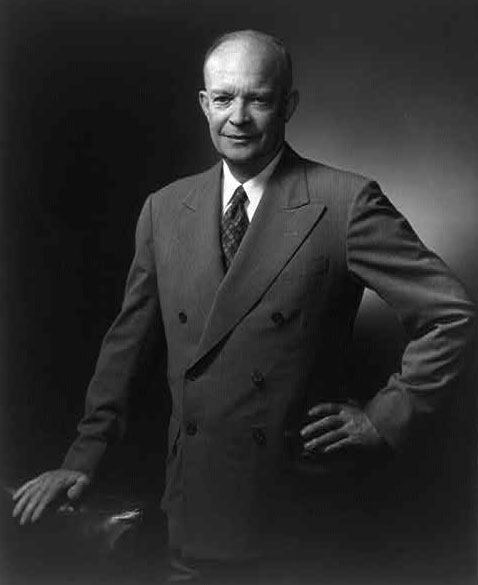
Before winning election to the presidency in 1952, Dwight D. Eisenhower had spent most of his adult life as an army officer, rising to the highest military rank, General of the Army. Both as a general and as president, Eisenhower aroused an enormous affection in the people of the United States and indeed in people throughout the world. This was because in a time of national danger, of changing values and uncertainty, he possessed the virtues that most Americans feel represent the United States at its best. He was brave, kind, steadfast, idealistic, friendly, and so completely honest that even his political opponents never questioned his integrity.
West Point
After he graduated from high school, Eisenhower went to work in a creamery, partly to enable one of his older brothers to attend college. When Dwight realized that the only chance of getting his own college education was to try for a free one, he took the competitive examinations for both the U.S. Naval Academy at Annapolis and the U.S. Military Academy at West Point. He placed first for Annapolis and second for West Point. He wanted to go to the Naval Academy, but he discovered that at 20 he was too old. At the Military Academy the age limit was 21.
Eisenhower entered West Point in 1911. His academic record was average. He stood 61st in a class of 164. But he was very popular. He was a big, powerful young man with a friendly grin. He was a star halfback on the football team until he hurt his knee. The knee bothered him the rest of his life.
Marriage and Early Military Career
Upon graduation in 1915, Eisenhower was commissioned a second lieutenant in the 19th Infantry and ordered to Fort Sam Houston in San Antonio, Texas. There he met Mary (Mamie) Geneva Doud of Denver, Colorado, and fell in love with her. They were married in Denver in 1916, on the day that Eisenhower was promoted to first lieutenant.
World War I
Eisenhower was promoted to captain in 1917 and then served as an instructor at several Army training camps. With the United States involved in World War I, he sought active service in France. But he was too good at training troops, and in 1918 he was assigned to command the Tank Training Center at Camp Colt, Pennsylvania. He was quickly promoted to major (temporary), and by the war's end, in November, 1918, he held the temporary rank of lieutenant colonel.
Peacetime Years
The peacetime years were routine for Eisenhower. He went back to his regular rank of captain and served at Camp Meade, Maryland, and in the Panama Canal Zone. In 1924 he was promoted to major again. In 1926 he studied at the Command and General Staff School at Fort Leavenworth, Kansas, from which he graduated first in his class.
During the next few years Eisenhower served on the Battle Monuments Commission in France. He also attended the War College in Washington, D.C. He served under the assistant secretary of war from 1929 to 1933, when he was appointed to the staff of General Douglas MacArthur, who was then chief of staff of the Army. When MacArthur undertook the task of building a Philippine army in 1935, he asked Eisenhower to go along as his assistant. In the Philippines, Eisenhower had a major role in planning the defense of the islands. In 1936 he was promoted to lieutenant colonel.
World War II
Eisenhower remained in the Philippines for four years. When World War II broke out in Europe in 1939, he was anxious to get home, for he foresaw that the United States must eventually become involved. He returned to the United States in December, 1939, and was assigned to the 15th Infantry as regimental executive officer. In 1941 he was promoted to colonel and made chief of staff of the U.S. Third Army. Later that year he was promoted to brigadier general.
Pearl Harbor
On December 7, 1941, Japanese planes attacked U.S. bases at Pearl Harbor, Hawaii, bringing the United States into World War II. Eisenhower was promoted to major general in March 1942, and in April he was appointed to the position of chief of operations under Army Chief of Staff General George C. Marshall.
In May 1942, Marshall sent Eisenhower to England. That June, Eisenhower was chosen to command all U.S. forces in Europe. He was promoted to lieutenant general.
North Africa
When the Allied invasion of North Africa was agreed on, Eisenhower was given command of all British and U.S. forces. On November 8, 1942, the troops were successfully landed in Algeria and Morocco. However, the German Army in Africa reacted sharply, beginning six months of bitter fighting. Eisenhower had never commanded even a division in the field, and he had to learn the techniques of command while fighting. The Americans suffered an almost disastrous defeat at Kasserine Pass in Tunisia, before Eisenhower got hold of the situation and his raw American troops settled down. In February, 1943, he was promoted to full general. The British and U.S. forces, assisted by the Free French, defeated the Germans and their Italian allies in North Africa, taking more than 250,000 prisoners.
Italy and Supreme Commander
Allied forces under Eisenhower's overall command had occupied the Italian island of Sicily by the summer of 1943. In September, 1943, they landed at Salerno, on the mainland of Italy. In the winter of 1943, President Roosevelt, British Prime Minister Winston Churchill, and Soviet leader Joseph Stalin met at Teheran, in Iran, and agreed on plans for the invasion of France the following year. At the Cairo Conference, which followed, it was decided that Eisenhower was to be appointed supreme commander of the Allied expeditionary force. In January, 1944, Eisenhower arrived in England to take command. D-Day, the date for the Allied invasion of Normandy in western France, was set for June 5, 1944.
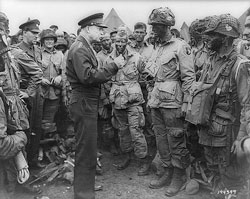
D-Day.
On Saturday, June 3, the weather was bad. The invasion was postponed one day. Monday morning, June 5, at 4:00 a.m., forecasters said weather conditions might clear enough by Tuesday, June 6, to make the landings possible. Otherwise they must be put off for about three weeks. Eisenhower asked his generals for their opinions. Some were for going on, some for postponement. He got a final weather check; then he said the historic words: “O.K. We'll go ahead!”
By early September, 1944, Paris was liberated and the Germans were driven back to the borders of Germany. But the Allied armies had outrun their supplies and had to stop. This gave the Germans time to recover.
Battle of the Bulge
On December 16, 1944, the Germans launched their last great offensive, which became known as the Battle of the Bulge. German armored divisions almost succeeded in breaking through the thin, stretched-out Allied lines. In this dangerous position Eisenhower never lost his calm optimism. He made the necessary decisions to meet and counter the German attack. Then he took to his jeep and rolled over the snowy roads of France and Belgium to encourage the hard-pressed front-line troops.
Victory
When the Germans were stopped at the Bulge, Eisenhower, now holding the rank of general of the Army, proceeded with his plan for the conquest of Germany. His British and U.S. generals sharply disagreed about these plans. By tact, persuasion, and finally the assertion of authority, Eisenhower got them to work as a team. The British themselves said that no one but “Ike” could have kept such temperamental characters as British General Bernard Montgomery and U.S. General George Patton working in harmony. Their armies swept through Germany from the west while the Soviet Army attacked from the east. On May 7, 1945, the German High Command signed an unconditional surrender at Eisenhower's headquarters in a schoolhouse in Reims (Rheims), France.
Postwar Years
Eisenhower returned home to demonstrations of affection and enthusiasm by the American people. In November, 1945, he succeeded General Marshall as Army chief of staff.
Eisenhower retired from active military service in 1948. He published an account of his wartime experiences, Crusade in Europe, and in 1949 accepted the post of president of Columbia University.
Eisenhower returned to active duty in 1950, at the height of the Cold War with the Soviet Union. President Harry S Truman appointed him supreme commander of the forces of the recently formed North Atlantic Treaty Organization (NATO), a defensive military alliance made up of the United States, Canada, and a number of European nations.
As early as 1947 both the Democratic and Republican parties had sought to make Eisenhower their presidential candidate. In the tradition of American military leaders, Eisenhower had never taken part in partisan politics. He firmly refused offers from both parties. However, by 1952, he had come to feel in tune with the principles of the Republican Party. He resigned his NATO command that year to campaign for the Republican presidential nomination.
President
Eisenhower easily won the Republican nomination on the first ballot. In the 1952 election, he defeated the Democratic candidate, Adlai E. Stevenson, by 442 to 89 electoral votes. Eisenhower's Vice President was Richard M. Nixon, who was later to win election to the presidency himself.
First Term
As president, Eisenhower tried to lead the United States in a program of cooperation with all free nations and strong opposition to Communism. In this he relied heavily on the advice of his secretary of state, John Foster Dulles. Eisenhower was not completely successful, but he did have some notable achievements. The first of these was bringing an end to the fighting in the Korean War in 1953. His Atoms for Peace program assisted other nations in developing atomic energy for peaceful uses. The Southeast Asia Treaty Organization (SEATO) was set up in 1954 to prevent Communist aggression in Southeast Asia. (SEATO was phased out in 1977.) The President's integrity was seen during the 1956 Suez crisis, when he criticized three U.S. allies—Britain, France, and Israel—for their attack on Egypt after it had nationalized (taken control of) the Suez Canal.
Illness and Re-election
In 1955, Eisenhower suffered a severe heart attack. But after a few months he was again able to resume his full activities. Twice more he was sticken with serious illnesses, once by an intestinal attack that required a major operation and later by a slight stroke.
Despite his illnesses, Eisenhower decided to run for re-election in 1956. Again his opponent was Adlai E. Stevenson. Eisenhower received 457 electoral votes to Stevenson's 73. His popular vote of nearly 35,590,000 was the largest ever received by a U.S. president up to that time.
Second Term
During his second term, President Eisenhower was even more heavily involved in foreign affairs. To help protect the nations of the Middle East from Communist aggression, Eisenhower in 1957 offered to send them military aid if they requested it. This proposal became known as the Eisenhower Doctrine. In 1958, under the terms of the doctrine, Eisenhower sent U.S. Marines to Lebanon to prevent a Communist takeover of its government. He also ordered ships of the U.S. Seventh Fleet to Taiwan to prevent a possible invasion, by the Communist Chinese, of the islands of Quemoy and Matsu, which were held by the Nationalist Chinese. Closer to home was the problem of Cuba. The seizure by Cuba of U.S. property and the establishment of a Communist government on the island prompted Eisenhower to break relations with Cuba in 1961. The U-2 incident, in which a U.S. spy plane, the U-2, was shot down over the Soviet Union, was an embarassment to the administration.
In 1954 the U.S. Supreme Court had handed down a historic decision, declaring the segregation of white and black children in public schools unconstitutional. Eisenhower had hoped for peaceful integration, but he did not hesitate to send U.S. military units to a Little Rock, Arkansas, high school in 1957, in order to enforce the law.
Retirement
After leaving the White House in 1961, Eisenhower retired with Mamie to the farm he had purchased at Gettysburg, Pennsylvania. One of the first acts of the new president, John F. Kennedy, was to restore Eisenhower to his rank of general of the Army. Eisenhower wrote several books, including Mandate for Change (1963) and Waging Peace (1965). He died on March 28, 1969, in Washington, D.C., and was buried in Abilene, Kansas.
Alden Hatch
Author, General Ike
Reviewed by John S. D. Eisenhower