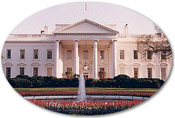









JAMES MONROE
Biography
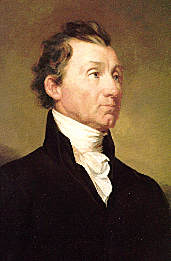
James Monroe was the last of the Virginia Dynasty presidents. (These also included Thomas Jefferson and James Madison.) He was a professional politician who spent virtually his whole adult life in the public service, steadily rising to ever higher office. A modest man, Monroe was overshadowed by the brilliance of his great contemporaries. Yet his modesty and integrity won him wide esteem and the unwavering loyalty of his friends.
His Political Career
Monroe embarked upon his political career with single-minded concentration. No rebuff halted him, and no defeat slowed him for long. From 1782, when he was elected to the Virginia House of Delegates at the age of 24, until 1825, when he left the White House at the age of 66, he was in public office almost without interruption.
Monroe was a member of the Congress of the Confederation, by which the United States was governed before the adoption of the Federal Constitution. He was a delegate to the Virginia Ratification Convention, where he opposed adoption of the Constitution because he felt it centered too much power in the federal government. He was a United States senator, acting in opposition to the Federalist Party. He was four times governor of Virginia. He was minister to France, Spain, and Great Britain. He was secretary of state as well as secretary of war. Finally, he was a two-term President Of The United States.
Monroe was sent to Paris in 1803 by President Jefferson to negotiate the sale of New Orleans to the United States and to acquire the right of free navigation on the Mississippi River. The French surprised them with the sudden offer, by Napoleon, to sell the United States the whole Louisiana Territory. After some haggling with the French minister of finance, Monroe and Livingston signed the treaty, which was dated April 30, 1803. By its terms the United States acquired all of the Louisiana Territory for a total cost of 80,000,000 francs (about $15,000,000). The Louisiana Purchase was beyond a doubt the greatest real estate bargain in history. In one stroke it doubled the territory of the United States. The transaction also enhanced Monroe's reputation.
After Paris, Monroe went to London, and then for about a year to Madrid, as American minister. In these wartime capitals (the Napoleonic Wars were then raging) his diplomatic activities were not fruitful, partly because of British hostility. In 1807 he returned home. There his Virginia friends were trying to promote him as successor to Jefferson in the presidency. Monroe was willing, but the nomination and election went to James Madison. Monroe refused the governorship of Louisiana and resumed political life in Virginia, first as member of the state legislature and then as governor.
In 1811 Monroe accepted President Madison's offer of the post of secretary of state. He held this position throughout the War of 1812 and until the end of Madison's second term. In 1814 Monroe also became secretary of war. His energetic policies as war secretary were given some of the credit for the American victories at Plattsburg in 1814 and at New Orleans in 1815. They also helped him toward his nomination for the presidency in 1816.
President
Monroe was elected president in 1816. He received about 84 percent of the electoral votes cast (183 out of 217 votes) and carried 16 of the 19 states of the Union. In 1820, when he ran for a second term, his triumph was even greater. This time he received all but one of the electoral votes (231 out of 232). He would have received all the electoral votes had not one elector felt that nobody should share that historic honor with George Washington.
Monroe's administration came to be known as the Era of Good Feeling. It was a period of national optimism, expansion, and growth. There were no major domestic problems to trouble the President. The looming slavery issue was settled, at least temporarily, by the Missouri Compromise of 1820. In regard to internal improvements, Monroe in 1822 vetoed the Cumberland Road bill as unconstitutional. However, he recommended a Constitutional amendment to give the federal government power in the field of “great national works.”
Foreign Affairs
The Monroe Administration was especially notable in the field of foreign affairs. The able diplomacy of Monroe's secretary of state, John Quincy Adams, resulted in a number of achievements of lasting benefit to the United States. The Convention of 1818, held in London, settled the boundary between the United States and British North America (Canada) and fixed the northern line of the Louisiana Purchase. In the following year the western limit of the Louisiana Territory (from the Sabine River, on the Gulf of Mexico, along the Red and Arkansas rivers to the Pacific Ocean) was defined by the Adams-Onís Treaty with Spain. In the same treaty the United States also acquired East Florida and a claim, which Spain renounced, to West Florida.
The Monroe Doctrine
The most memorable event connected with Monroe's presidency was the proclamation of the Monroe Doctrine. In 1822 the Austrian, French, Russian, and Prussian monarchies considered the possibility of restoring Spanish power in South America. But the British foreign minister, George Canning (1770-1827), was unwilling to see the European nations, especially the French, intrude into the Western Hemisphere. He approached the American minister in London about a joint action on Latin America. This proposal was reported to Monroe. After consulting with his Cabinet and seeking the advice of Jefferson and Madison, Monroe decided to take a step independently of Great Britain. This was a public declaration of American policy, expressed in a message to Congress on December 2, 1823.
The Monroe Doctrine, as embodied in the President’s message, comprised four main points:
- the political system of the Americas was different and separate from that of Europe
- the Americas were no longer to be regarded as subjects of European colonization
- the United States had no intention of interfering with the European “colonies or dependencies” already existing in the Americas
- the United States would be hostile to any extension of European power in the Americas
For more than a century this doctrine remained the foundation of American foreign policy. It guided United States relations with Europe, particularly in regard to Latin America.
Later Years
Upon is retirement from the presidency, in March, 1825, Monroe returned to Oak Hill, his home in Loudoun County, Virginia. In 1826 he became a regent of the University of Virginia. And in 1829 he presided over the Virginia State Constitutional Convention. After the death of his wife, Eliza, in 1830, Monroe, lonely and ill, went to live with his daughter, Mrs. Samuel L. Gouverneur, in New York City. There he died on July 4, 1831, at the age of 73. In 1858, on the 100th anniversary of his birth, his remains were moved to Richmond, Virginia.
Monroe was about 6 feet tall, with grayish-blue eyes and a lined face that conveyed an expression of kindliness. Somewhat colorless, he yet inspired universal respect for his modesty, solid judgment, and quiet administrative ability. The crusty John Quincy Adams, who followed Monroe in the presidency, paid his predecessor this tribute:
“Monroe ... was ... of purposes always honest and sincere, of intentions always pure, of labors outlasting the daily circuit of the sun ... ; of a mind anxious and unwearied in the pursuit of truth and right; patient of inquiry; patient of contradiction; ... sound in its ultimate judgments; and firm in its final conclusions.”
Unavoidably, Monroe has suffered by comparison with his brilliant contemporaries, particularly Jefferson and Madison. But his many years of devoted service to the United States in the country's most formative period entitle him to esteemed remembrance.
Saul K. Padover
Author, The Genius of America